
Self-Hosted Agents Move the Control Plane. They Also Move the Operating Burden.
Self-hosting relocates an agent control plane. Enterprise teams must still prove isolation, control inference disclosure and operate recovery.
Enterprise AI6 min read

A bank can bring an agent service into its own cloud account and still send sensitive material outside it. It can isolate a worker in a container and still grant that worker excessive authority. The location of a component answers one architectural question; the permissions and information flows around it answer several others.
Anthropic's 12 November 2026 announcement of self-hosted Claude Managed Agents makes these distinctions immediately practical. The option moves the service as well as tool execution onto customer infrastructure, while inference remains with a configured provider. For enterprise architects, the consequential development is the ability to choose a different placement for the agent control plane. The evaluation must then examine what the organisation can operate, prove and contain.
Three placements, three responsibility models
The self-hosting overview, verified on 13 November, distinguishes hosted execution, customer-hosted sandboxes, and a customer-hosted service plus sandboxes. The latter includes the API, agent loop and session storage. It requires PostgreSQL 16 or later for persistence; without a database, a restart erases in-memory state. Access is requested through the vendor account team, according to the dated release notes.
These are documented product behaviours, not independent evidence of production resilience. A bank evaluating this option should ask its platform team to draw the deployment and its failure domains before discussing agent sophistication. Who owns the database backup? Which team can restore it? What happens to queued tool work during an upgrade? Which component records an externally completed action if the service fails immediately afterwards?
Consider an illustrative document-review workflow. An agent reads a corporate customer's evidence pack, proposes missing documents and creates a case-management task. Local session storage could help the bank control retention and administrator access. Yet the case-management write remains a business operation with its own identity, permissions and outcome. A restored session must discover whether that task already exists before attempting to create it again.
Hosting therefore changes the available controls and the team's obligations. It does not, by itself, settle the end-to-end design.
The inference boundary remains consequential
The vendor's data-and-access documentation says model calls include conversation history, prompts, tool inputs and tool results. It also describes a deployment as serving one tenant at one trust level, with separate deployments recommended for different tenants or trust levels. Environments inside a deployment are not the isolation boundary. This is a particularly consequential constraint for a consultancy serving multiple banks.
A proposed Azure architecture should therefore distinguish three inventories: data stored in the agent service, data released to inference, and data available to workers. Those sets may overlap, but they should never be assumed identical. A model gateway can be a useful enforcement point only if the actual provider, identity, payload and network paths pass through it as designed.
For the document-review example, a retrieval adapter might return a short, authorised passage with a stable evidence identifier rather than an entire customer file. That is a proposed minimisation strategy, not a claim about the product's automatic behaviour. The tradeoff is real: the model receives less surrounding context and may need another retrieval step. The team should measure whether the reduced disclosure causes more incomplete reviews, extra calls or ambiguous citations.
A bank also needs to decide which traces contain raw content. Debugging an unsuccessful review is easier with complete payloads. Broad trace access, however, can recreate the very disclosure path that a carefully restricted retrieval service was intended to prevent. Operational usefulness and data minimisation must be evaluated together.
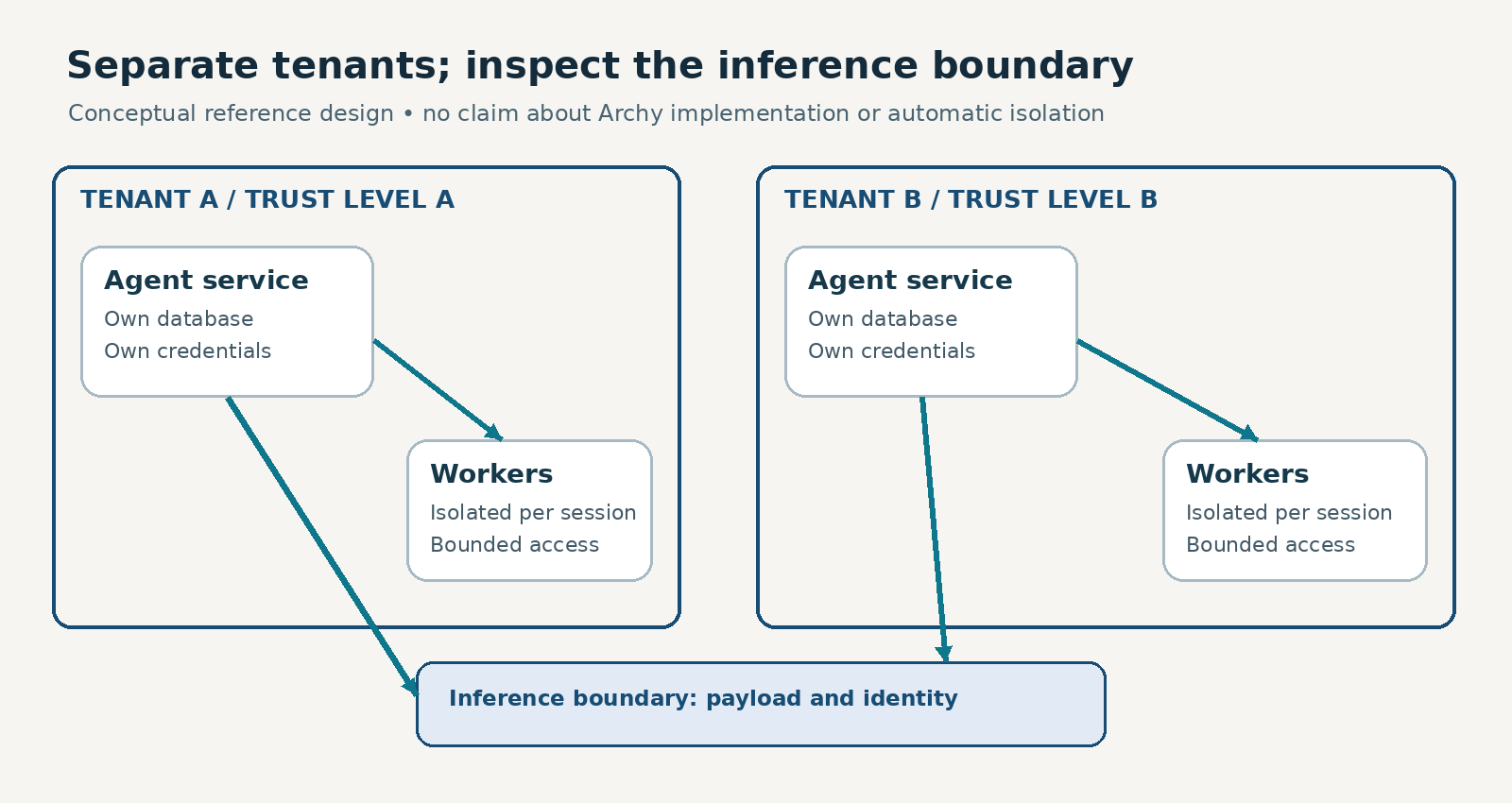
Conceptual architecture: separate service, database and worker deployments for tenants A and B; each reaches a controlled inference boundary. This is a proposed reference design, not a verified Archy deployment or a complete security specification.
A sandbox needs an authority design
The deployment overview warns that the shell has the worker's permissions and network reach; the worker itself does not supply isolation. Architects should convert that warning into a concrete execution policy. For example, a review worker can receive an ephemeral filesystem, a bounded network route to document services and a credential that cannot amend customer records. A separate approved step can perform the case-management write.
That separation has a cost. It adds a handover, another service interaction and a record that must be reconciled. It may also make the system easier to inspect: the review step produces evidence, the approval step names the permitted action, and the write step records the result. The appropriate boundary depends on the consequence of a mistake, not on a universal preference for more components.
Prompt instructions can help the agent choose sensible actions. Enforcement must survive an agent choosing an unreasonable one. The useful test is to execute a deliberately disallowed tool request and observe which component denies it, what evidence it records, and whether subsequent retries remain denied.
For Archy's Azure-based platform, this is an evaluation requirement rather than an asserted capability. An open orchestration proposition becomes more credible when tenant identity, tool permissions and action outcomes remain explicit across provider adapters. The label “open” alone says little about those properties.
API compatibility does not establish workflow parity
The vendor documents important differences from its hosted service. Delegation is limited to predefined agents; dynamic workflows and the advisor are unavailable in this deployment mode. Tool work can wait without an error when no worker is polling. MCP destinations require an allowlist. An oversized custom tool result can produce a successful HTTP response followed by a session error.
Each behaviour suggests a different acceptance test. A workflow that depends on dynamically defining specialists needs redesign or a different runtime. A deployment with no active worker needs a queue-age alarm rather than a dashboard that merely counts API errors. A retrieval adapter needs an output budget that is tested with unusually large records. An HTTP success metric cannot stand in for a completed business task.
These tests should be written around the bank's workflow. For a document review, useful outcomes include a correctly supported recommendation, no cross-customer disclosure, a uniquely created follow-up task and a recoverable interrupted run. Token counts and response times help explain those outcomes, but cannot substitute for them.
The consulting opportunity is an operating decision
For Architech, the useful engagement is a comparative architecture assessment: which responsibilities belong with the bank, which remain with providers, and what evidence supports that allocation? A short pilot can compare deployment effort, permission boundaries, upgrade procedures and incident recovery using the same representative workflow.
The commercial comparison should include ongoing patching, database operations, observability, on-call coverage and release qualification. An organisation may rationally accept a managed control plane if the operational burden of self-hosting outweighs its benefit. Another may require local session administration strongly enough to fund the additional capability. Neither conclusion follows from the announcement alone.
The next evidence to watch is practical: access conditions, support commitments, documented upgrade compatibility and results from failure-injection exercises. A successful demonstration should include a stopped worker, a service restart, a restored database and a denied cross-tenant request. Until those tests are run, self-hosting is an architectural option with a clear responsibility shift, not a demonstrated resilience outcome.