
Your Model Upgrade Is Also a Conversation Contract Migration
A model release can change the rules for conversation history, tool updates and fallback. Qualify the transition as part of the workflow.
Enterprise AI7 min read

The upgrade looks harmless in a pull request: replace one model identifier with another. The first request succeeds. A later turn fails because the application has quietly rewritten an earlier instruction, refreshed its tools or rebuilt a response without preserving every content block. The model is available; the conversation is no longer compatible with the way the application constructs it.
Claude Fable 5.2, released on 9 November 2026, makes this an immediate engineering concern. The important strategic lesson extends beyond a single model family. An enterprise agent does not consume an interchangeable text-completion function. It consumes a protocol with state, content types and transition rules. An open orchestration platform needs to make those rules visible at its adapter boundary.
The material change is in later turns
Anthropic's release notes document universal prefix checks for the new pair of Fable 5.2 and Mythos 5.2 models. A request that changes earlier conversation material and then returns affected thinking blocks can receive a 400 error. The notes list Fable 5.2 availability in Microsoft Foundry, but that listing is not proof of access, capacity or feature parity in a particular Azure deployment.
The vendor's migration guide, checked on 13 November, explicitly calls out applications that construct their own messages array. Changes to the system prompt, tools or earlier messages can invalidate subsequent thinking. Repeating the same request does not resolve the mismatch. A temporary drop-block option exists, with potential additional output-token cost; the guide recommends fixing the underlying edits.
These are documented interface behaviours. They do not establish a measured improvement or regression in a bank's workload. The relevant engineering question is whether a complete workflow remains valid across turns, interruptions, tool updates and model transitions.
Mutable configuration creates hidden history edits
Imagine a corporate-banking assistant whose tool catalogue is assembled from a live service registry. On Monday morning, a tool description is updated to clarify a parameter. An existing conversation later resumes. The application reconstructs the original request using today's catalogue, then adds yesterday's stored responses. Its own business state may be correct, while its reconstructed model history is inconsistent.
This is an illustrative failure scenario, not an observed incident at Archy. It reveals a general design choice: does a session reference a versioned configuration, or does it inherit whatever configuration is current when it resumes?
A versioned configuration makes reproduction easier. The team can inspect which tool schema and instructions shaped a decision. It also creates maintenance work: old configurations need an expiry policy, vulnerability handling and compatibility support. A continuously refreshed configuration simplifies central updates but requires an explicit transition strategy for active sessions. Neither choice removes the need to handle a revoked permission immediately.
That last point matters in banking. An old tool definition can remain part of an immutable transcript while the execution gateway denies its use under current policy. Historical fidelity and current authorisation serve different purposes. The former explains what happened; the latter decides what may happen now.
Preserve the protocol and govern the transition
The vendor's guidance for changing tools and instructions recommends preserving prior content and appending supported updates. It also requires complete assistant content arrays, including signed blocks whose visible text may be empty. Supported update mechanisms vary by model and platform, so the adapter must use the documented path for its actual destination.
An application serializer is consequently part of the production protocol. A filter that removes an empty-looking block can change meaning. A trace export intended for human reading may be unsuitable as the source for replay. A generic messages abstraction can remain useful, but only if it retains the information required by each provider and identifies transformations that lose it.
For an open platform such as Archy, a sensible engineering experiment would compare a lossless provider-specific record with the platform's normal serialization and reconstruction path. It should test streaming responses, interrupted streams, empty text, tool results and persisted sessions. This is a proposed test, not a claim that Archy currently stores or transforms any particular block incorrectly.
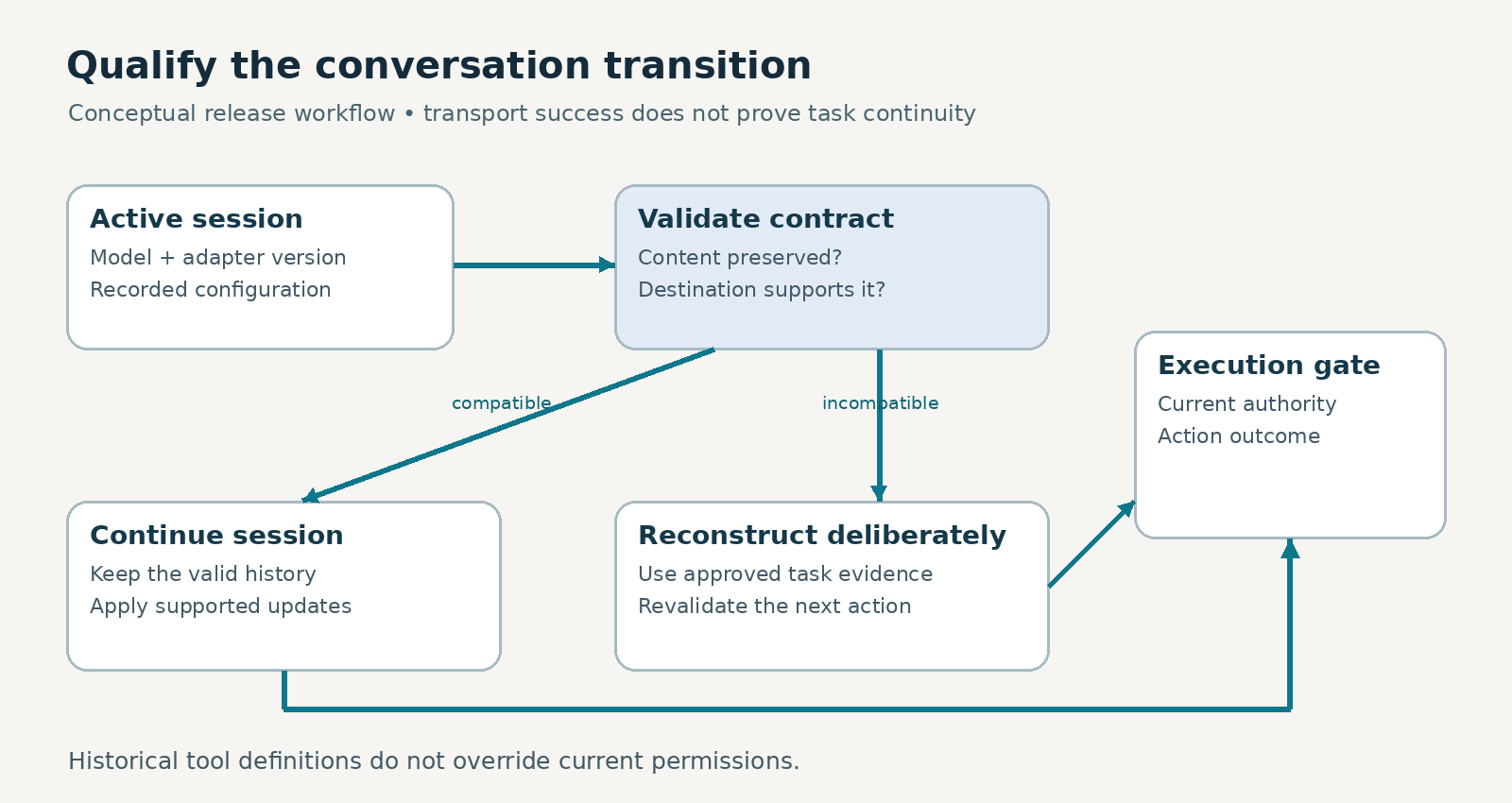
Conceptual release workflow: classify active sessions, validate their conversation contracts, continue compatible sessions and deliberately reconstruct incompatible ones. Execution still checks current authority. No performance data is implied.
Fallback changes the execution context
The release notes also document asymmetric thinking-block compatibility: moving from the new model pair to other models drops those blocks. A request can succeed while subsequent reasoning proceeds without that state. Engineers should therefore distinguish a successful transport response from continuity of execution context.
Consider a review that has compared several contract clauses and is preparing a recommendation. A fallback model may receive the visible conversation while losing a provider-specific reasoning representation. The correct response is not to assume either failure or equivalence. It is to test the observable result against the evidence and requirements that matter to the task.
For a low-consequence summarisation, a fresh reconstruction from approved source material may be acceptable. For a workflow preparing an externally binding action, reconstruction may require another validation or approval step. The decision should be attached to the workflow's consequence and evidence requirements rather than a universal fallback rule.
This affects product economics. A cheaper model call can trigger more retrieval, regeneration or review work. Conversely, a deliberate fresh session may be easier to control than a complex attempt to preserve opaque state across providers. The cost comparison should include the complete successful task and its recovery path.
Test transitions, not only answers
A migration evaluation needs ordinary quality tests, but also sessions that exercise the application over time. Start with an active session, change an instruction through the supported mechanism, revise a tool catalogue, revoke an entitlement and resume after persistence. Observe both whether the request is accepted and whether the business workflow behaves correctly.
Separate the causes of failure. A prefix mismatch is a request-construction problem. A denied tool invocation may be the intended result of an authorisation change. A plausible answer with unsupported evidence is a quality failure. A duplicate external action is a transaction-control failure. A single aggregate success rate can conceal all four.
The migration record should identify the adapter version, model destination, configuration version, reconstruction policy and evaluated workflow. Teams can then decide whether a new release is safe for new sessions only, for selected active sessions, or for a broader rollout. A staged policy also gives support engineers a concrete explanation when an old session is deliberately restarted.
What leaders should ask before approving rollout
For Architech, this creates a useful consulting deliverable: a conversation-contract assessment alongside the usual model evaluation. It should expose the assumptions in SDKs, middleware, persistence and fallback routing, then demonstrate representative transitions. The assessment is particularly relevant where several teams share a platform but build their own message transformations.
For Archy, the strategic opportunity is a clearly specified provider boundary: what can continue, what must be reconstructed, what evidence survives, and which actions require fresh approval. Those are positioning choices to validate, not capabilities to claim without implementation evidence.
The immediate decision is to qualify the upgrade as a workflow release. Watch actual error rates, end-to-end task quality, recovery behaviour, latency and total cost under the deployed Azure configuration. Vendor capability claims can motivate the experiment. Only the organisation's own transition tests can show whether its application is ready to switch.