
Agent Analytics Can Count Activity. Your Business Case Needs a Denominator.
Microsoft’s Agent 365 Business Analytics preview brings cost and usage together. Business value still needs verified outcomes and an explicit cohort.
Enterprise AI7 min read

An agent becomes popular. Sessions increase, more teams adopt it and the dashboard shows rising usage. The technology leader still cannot answer a basic question: did the organisation complete more useful work at an acceptable cost and level of risk?
Microsoft’s 17 November 2026 Ignite announcement introduced Agent 365 Business Analytics with a promise to connect AI spending and business value. That is a consequential platform move for organisations already investing in Microsoft’s AI estate. It also makes the distinction between activity telemetry and business evidence more urgent.
The current product documentation identifies the experience as Frontier preview. Its capabilities and availability can change. The announcement is evidence of Microsoft’s direction, not independent proof that a dashboard establishes causal return on investment.
What the reporting actually observes
The documented Agents page brings together adoption, cost, use-case and model-provider insights. Its reporting views have different scopes. Third-party agent insights require Agent 365 licensing, and the prerequisites include at least 50 assigned Microsoft 365 Copilot licences and agent activity. This is relevant to qualifying customer deployments; it should not be assumed available to every small consultancy or Azure application.
These constraints belong in the evaluation plan. Before comparing teams or suppliers, establish which agents, people, billing models and time periods are actually represented. A dashboard can be internally correct and still cover only part of the workflow the business wants to assess.
For a bank evaluating an onboarding assistant, usage might include document questions, repeated searches, revised recommendations and abandoned cases. More activity could mean better adoption. It could also mean that employees need more attempts to complete the same work. The interpretation requires a business outcome recorded outside the usage counter.
Define the unit before calculating value
Choose a unit the business recognises. “An onboarding case accepted by the responsible reviewer” is a more useful denominator than “a model response” when the intended value is a completed onboarding review. It is still incomplete unless the definition specifies what evidence is required, how corrections are handled and when acceptance becomes final.
The workflow then needs a stable case identifier that can join operational records without copying sensitive case contents into every analytics system. That identifier can connect attempts, retrieval activity, review decisions and destination-state evidence. It should not become an access token or a reason to expose the underlying documents to every report consumer.
A cost-per-accepted-case measure can include model consumption, retrieval, infrastructure, human review and rework. Which costs are allocated, and how, should remain visible. Shared platform expenditure does not disappear merely because it cannot be attributed precisely to an individual case. Nor should a team invent a level of precision that its billing and staffing records cannot support.
This measurement design can be implemented independently of the reporting platform.
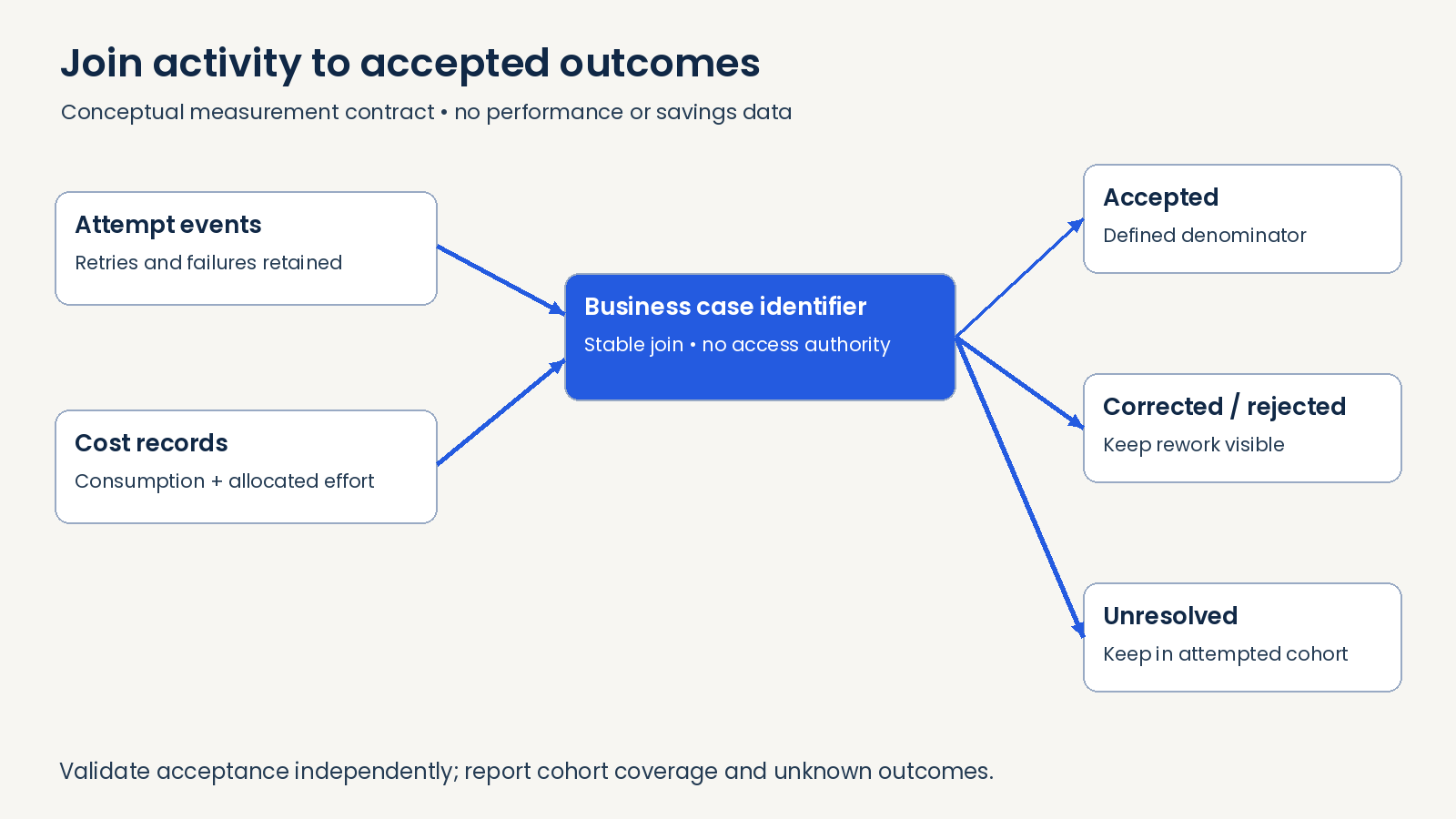
Conceptual measurement contract: operational events and cost records join through a stable business identifier; acceptance and corrections determine the denominator. No quantitative performance or savings are implied.
Keep unsuccessful work in the accounting
The most attractive-looking result can come from excluding the difficult cases. If a report counts only successful completions but omits their failed predecessors, it understates the effort required to produce those completions. If interrupted cases disappear from the cohort, it may also overstate reliability.
Keep the set of attempted cases explicit. Distinguish accepted, rejected, abandoned and unresolved work. An unresolved outcome should remain unresolved until the available evidence supports a classification. Operational teams can then ask whether the system is failing safely, simply stalling or declaring success without sufficient support.
The same discipline applies to human effort. A reviewer’s correction is part of the delivery cost even if the model call was inexpensive. A recommendation that saves preparation time but creates more verification work may still be worthwhile, but the tradeoff must be measured rather than hidden inside a time-saved estimate.
For a useful pilot, agree on these categories before examining the results. Changing the acceptance rule after seeing a disappointing outcome makes the comparison harder to trust. Corrections to the measurement process should be versioned and explained, with earlier results retained where appropriate.
Sessions and cases have different boundaries
Microsoft’s Agents documentation defines conversational sessions using a 30-minute inactivity boundary, while autonomous sessions can begin from a trigger such as a schedule or another agent. It also notes that use-case insights may cover only a portion of sessions and displays that coverage. These are reporting semantics, not definitions of a bank’s business transaction.
An onboarding case can span several sessions and employees. One session can help with several cases. A retry may create additional activity without producing another accepted outcome. Treating session counts as case counts would therefore introduce an untested assumption into the business case.
A practical reconciliation should sample the join between sessions and cases. Examine split sessions, shared sessions, retried work and cases completed outside the assistant. Missing links should be reported as coverage gaps. They should not automatically be classified as zero cost or zero value.
This work can reveal an uncomfortable but useful conclusion: the available telemetry is sufficient to manage adoption and consumption, while insufficient to estimate business value confidently. That is a reason to improve the measurement contract, not to discard the operational dashboard.
Compare alternatives without overstating causality
A before-and-after comparison can help identify changes, but many other factors can move at the same time: case complexity, staffing, process rules, seasonal demand and reviewer experience. Teams should describe those differences before attributing the change to an agent.
Where feasible, compare similar cases using a pre-agreed allocation method and a common acceptance rule. Keep exceptions visible. If operational constraints prevent a controlled comparison, use a narrower conclusion: the pilot demonstrated a particular completion rate and cost under the observed conditions. It did not establish what would have happened without the intervention.
The same caution applies to model or provider comparisons. Equal token budgets do not equalise human review, waiting time or recovery effort. An inexpensive route may become costly when it triggers more rework. A more capable route may justify its price for difficult cases while adding little value to routine ones.
These are engineering and product choices. The evidence should show which case classes benefit, what the quality boundary is and how the system behaves when it cannot complete the work.
Design reporting access as carefully as workflow access
The Business Analytics introduction documents role-based scope, organisational partitions and aggregation thresholds inherited from Viva Insights. These settings are part of interpreting who sees which insights. They do not establish permission to inspect every source document or individual case behind an aggregate.
A banking implementation should separate operational debugging, managerial reporting and financial reconciliation. Each audience needs different detail. Aggregated measures may be suitable for management, while a tightly controlled trace is needed to investigate an incorrect recommendation. Joining these views carelessly can create a new disclosure path.
Before scaling a pilot, agree a measurement contract for one workflow: the business unit, case cohort, acceptance evidence, cost scope, correction handling and reporting access. An orchestration architecture should preserve the relationship between a stable task identity, its attempt history and independently verified outcomes across adapters.
The next evidence to watch is whether the preview’s coverage, definitions and export paths fit real customer workflows. Adoption reporting can guide investment, and consumption reporting can control spend. A defensible business case additionally needs a denominator that the business trusts—and an honest account of the work that did not reach it.