
The Digital Euro Has Two Network Providers. PSP Resilience Still Needs a Design.
The ECB’s network-provider selection makes digital euro connectivity concrete. PSPs still need to reconcile uncertain payment outcomes and test their own failure boundaries.
Architecture7 min read

A payment service provider loses connectivity halfway through submitting an instruction. Its network monitor detects a broken path and switches traffic. The customer asks whether the payment happened. Restoring transport is useful, but it does not answer the customer’s question.
On 30 October 2026, the ECB announced the selection of two network service provider groupings for the digital euro: Nexi Payments with Deutsche Telekom Business Solutions, and Telefónica de España with Telefónica Global Solutions and Indra. The providers will connect participating PSPs and national central banks to the digital euro service platform and support communication between its components. ECB announcement, 30 October.
This is a material procurement milestone after a lengthy selection process. It makes the connectivity layer more concrete for PSP architects. It does not establish automatic failover between providers, exactly-once processing, or an operational digital euro available to the public. Those distinctions should shape the work commissioned now.
What the selection settles, and what it leaves open
The first-ranked provider’s contract entered into force on 28 September 2026, initially for pilot connectivity. The second starts in May 2027. The ECB says both are to be ready in 2029 for potential issuance, subject to its decisions, and PSPs will have a choice of either provider. The announcement does not say that every PSP will have simultaneous connections to both. ECB service-agreement statement.
That choice can support competition and architectural flexibility. It should not be translated into a resilience claim without an actual service design. Two contracts at ecosystem level can still leave an individual PSP with one access circuit, one gateway, one set of credentials and one operational team. Even a dual connection can share a last-mile carrier, power supply, DNS dependency or change process. A bank needs to identify common failure domains rather than count supplier names.
The original procurement notice provides useful context: it presents connectivity as a long-term service supporting the digital euro platform’s availability and resilience, and includes establishment and control conditions for relevant participants in Lot 1. It is a closed procurement document, not a new application opportunity. Official procurement notice, September 2025.
For a PSP, the next decision is a responsibility model covering its own gateway, provider connectivity and platform-facing integration. Before discussing active-active or standby operation, establish what the chosen service actually supports, what the pilot requires, which failures are visible to each party and how incidents are escalated. The public selection announcement is not a substitute for those interface and service documents.
A restored path does not settle an uncertain instruction
Payment integration has at least three relevant states: the communication attempt, the instruction accepted for processing and the final business outcome. A TCP connection, VPN tunnel or HTTP success code may provide evidence about one of these without proving the others. This is a general distributed-systems observation, not a claim about an undisclosed digital euro protocol.
Imagine a PSP submits instruction A and loses the response. When connectivity returns, blindly submitting a new instruction B could create a second payment. The safer design preserves the original intent and follows the platform’s documented status and retry contract. A transport switch should not silently rewrite business identity.
The ECB’s pilot FAQ describes VPN connectivity through an NSP and requires a unique Request-Id for a business instruction, reused only for an identical retry. Those are concrete pilot inputs to a test plan. They should not be expanded into promises about production failover or settlement guarantees. ECB pilot FAQ, updated 28 October.
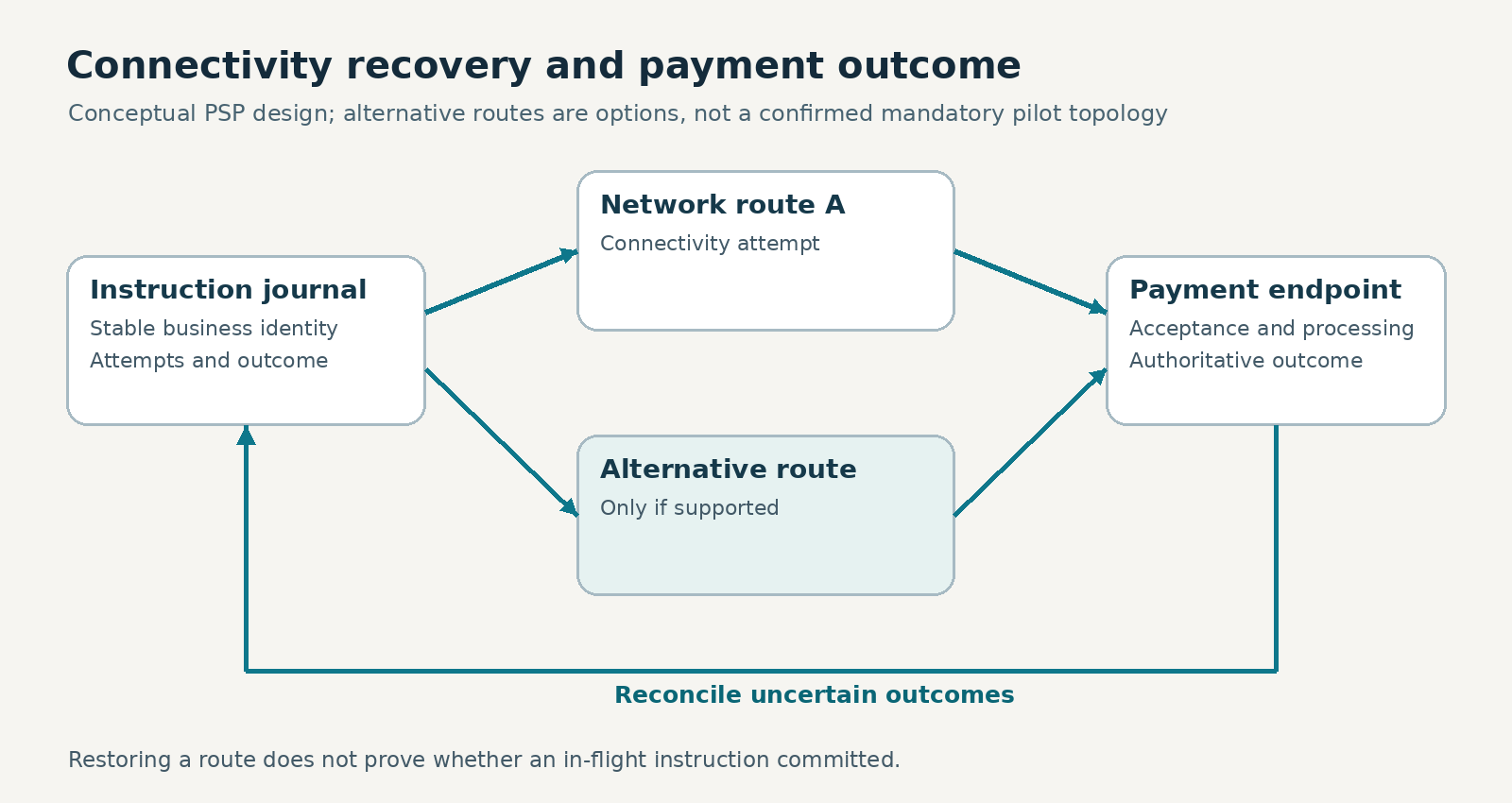
Conceptual PSP reference architecture: network routes carry attempts; a durable instruction record preserves identity and reconciles outcomes. Alternative routes are design options, not confirmed mandatory pilot topology.
An instruction journal can record the customer intent, immutable submitted payload, request identifier, attempts and confirmed outcome. The journal’s state should allow “outcome unknown,” followed by reconciliation. That is more honest than mapping every network error to failed payment. Customer channels can then display a pending state and avoid inviting another payment before the first has been resolved.
The operational tradeoff is additional state and exception handling. That work is justified when it prevents duplicates and gives support staff an authoritative answer. Its effectiveness should be measured with ambiguous-outcome tests, not inferred from the availability percentage of the network connection.
Test the boundary under partial failure
A useful PSP test starts with controlled disconnection at different points in the instruction lifecycle. Disconnect before submission, after the receiving endpoint accepts the request, and while the response returns. Then restore the same route or a permitted alternative. Observe whether the instruction identity survives and whether the customer, support desk and reconciliation service agree on the final state.
The test should also include a healthy network with an unavailable application endpoint. Otherwise the team may confuse connectivity monitoring with service health. A route that passes packets can still lead to a failing downstream component. Health checks should be chosen for the layer they actually establish, with care not to generate unintended business transactions.
Capacity after recovery matters too. Queued work can create a burst of instructions and status inquiries just when the service is recovering. Backoff, admission control and bounded queues can prevent that burst from becoming another incident. For a pilot, the objective is not to simulate every production volume; it is to establish whether the failure behavior is understood and the evidence is sufficient to diagnose it.
Security needs its own lifecycle. Certificates, network permissions and gateway identities can expire or be revoked while application components remain healthy. A recovery exercise should include those conditions and verify the escalation path. It should also establish which team may change routing or credentials, who approves the change and what evidence links it to the incident.
Procurement clarity creates a more specific consulting opportunity
For Architech, the award narrows the commercial map. A direct bid for this NSP procurement is no longer the route described by the announcement. Potential work lies with selected PSPs, their integration partners or the awarded provider groupings, subject to their actual needs and procurement rules. The award itself is not evidence that any of them is seeking a subcontractor.
A credible offer is a bounded connectivity-to-payment-state assessment: dependency mapping, responsibility allocation, retry and reconciliation review, a failure-injection plan and an operational acceptance report. That fits architecture and modernization expertise without claiming that Architech is already a selected participant or has special access to the platform.
The separate innovation-platform call was a different route, with its own participation terms. Its application deadline was 17:00 CET on 9 November 2026 and had passed when this article was checked on 13 November; the official announcement did not establish an extension. That call must not be conflated with the awarded network contract or admission as a pilot PSP. Future opportunities need their own eligibility and deadline checks. ECB innovation call, 28 September.
The lesson for open orchestration
Archy’s relevance is the boundary between attempts and accountable outcomes. An orchestration platform that connects enterprise tools faces the same class of uncertainty when a remote action succeeds and its reply is lost. It should preserve business identity across adapter or route changes and require evidence before declaring an effect complete. This is a product-design implication to investigate, not a claim that Archy processes digital euro payments.
Watch the providers’ onboarding specifications, the pilot’s tested connectivity behavior, documented service responsibilities and evidence from recovery exercises. The ECB’s award makes it possible to ask more precise integration questions. The architecture is ready only when a restored connection also leads to a controlled resolution of the business instruction that was already in flight.