A Five-Minute Thread Is Not Your Agent’s Memory
Claude’s message-thread beta reduces repeated conversation transmission. Enterprise applications still need durable task state, controlled retention and renewed authorization.
Enterprise AI7 min read

A bank’s service assistant prepares a response, asks an employee for approval, and waits. The employee returns after lunch. The business task still exists, the customer’s question still matters, and the permission to access the account may have changed. A short-lived model conversation is the wrong place to hold those facts together.
On 2 November 2026, Anthropic introduced message threads in beta for the Messages API, including Claude in Microsoft Foundry. The feature reduces repeated transmission of conversation history. That is a useful platform change for long agent loops, but its value depends on keeping three things separate: the conversation sent to the model, the durable business task, and the authority to use data or tools. Claude release notes, 2 November.
The engineering decision is whether to use temporary server state as an acceleration layer while retaining an application-owned record. Treating it as the agent’s lasting memory would make a performance optimization responsible for a business guarantee it does not provide.
What is actually being accelerated
A thread starts with the conversation, system prompt and tool definitions. Later requests carry new messages and a previous response identifier. Anthropic describes less repeated validation and tokenization, with lower and steadier time to first token. This is a vendor claim about the mechanism and expected performance, not an independently measured gain for a banking workload. Threads do not change the published pricing or rate limits. Message-thread documentation.
A practical evaluation should distinguish upload bytes, first-token latency, total completion time and billed consumption. Reducing the payload does not necessarily reduce the model’s reasoning time, tool latency or the work required to validate an answer. A retrieval-heavy task might spend most of its time searching documents. A case-management task might wait on a slow destination API. The improvement that matters is the distribution of complete workflow latency, including the occasions when the accelerated path is unavailable.
Consider a ten-turn analysis of an internal policy exception. If the same long document extracts are repeatedly sent, server-held context could reduce avoidable overhead. If the task consists of one short prompt followed by a long database query, the benefit may be small. Teams should measure both before changing their orchestration design or committing to an expected saving.
The application remains the record
The documented thread lifetime is five minutes after its last request, with deletion no later than one hour after last use. Storage is best-effort. When continuation is unavailable, the application must send the conversation again; the SDK helper can perform that replay, but its own history lives only in process memory. The feature is not eligible for zero data retention. Thread lifetime and data handling.
For the lunchtime approval scenario, the architecture therefore needs an independently durable task. That record should identify the initiating actor and tenant, the requested outcome, relevant source versions, the proposal awaiting approval and the current phase. Conversation history can be linked to it, but a task should remain understandable without reconstructing its state from a chat transcript.
The distinction also improves portability. An open orchestration layer can retain a provider-neutral record of business intent while its adapters manage provider-specific response identifiers. Moving a task to another model or recreating a thread then becomes an explicit reconstruction step. It does not require pretending that all providers mean the same thing by session, conversation or memory.
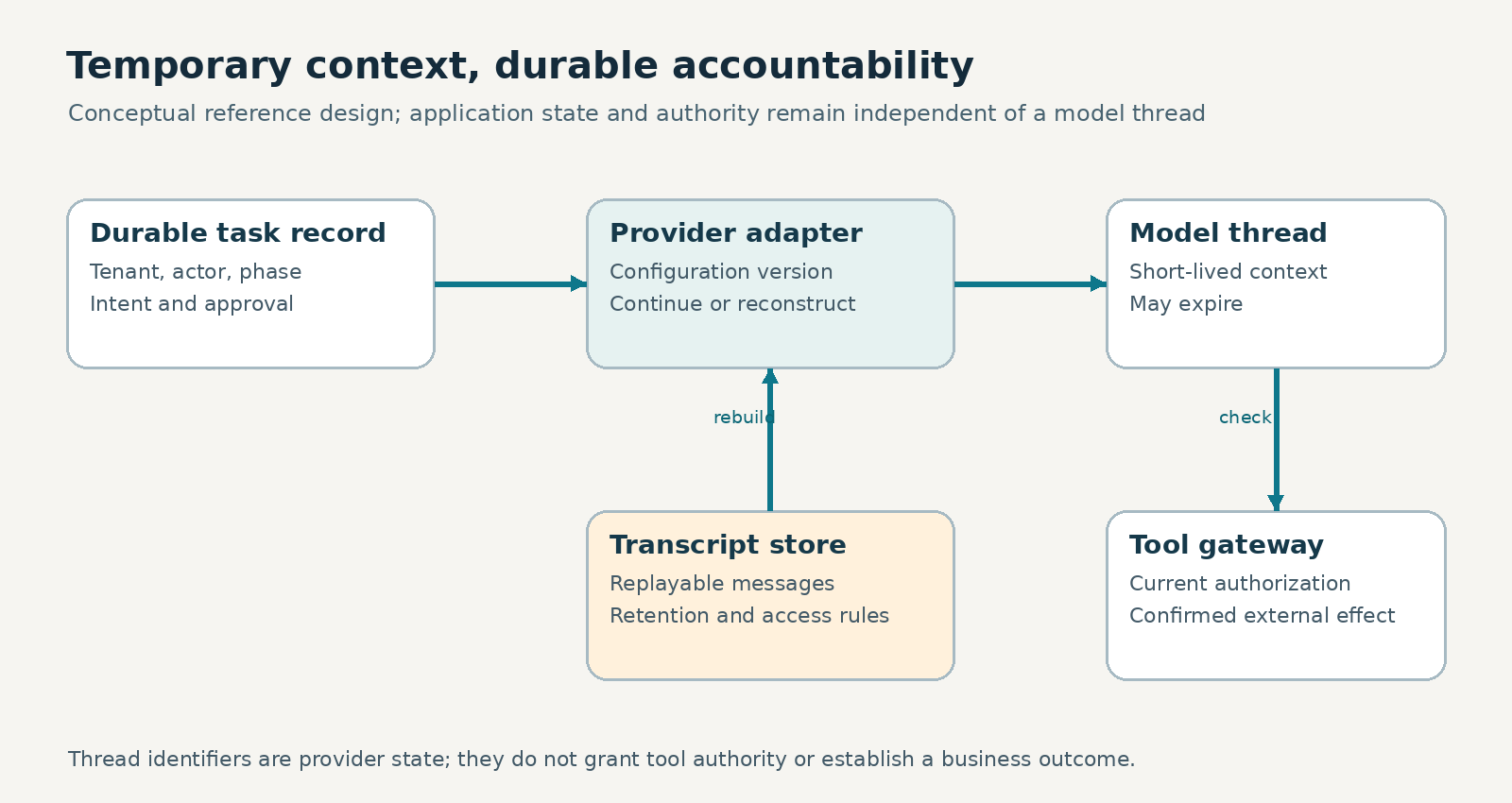
Conceptual reference design: the application keeps the task and replayable transcript; the provider thread accelerates a sequence of model calls. Tool authority is checked independently.
Retention creates a real tradeoff. Retaining a complete transcript makes replay possible, but it also creates a store of customer questions, retrieved passages and tool results. A bank should define who can access that store, which fields it needs, how long it keeps them, and what happens when a source is corrected or access is revoked. Keeping everything indefinitely is not a necessary consequence of supporting replay. A bounded transcript, source references and an explicit task summary may be sufficient for some workloads, provided the resulting behavior is tested.
Replaying context does not renew authority
Suppose an employee loses access to a customer portfolio while a task is paused. The transcript may contain material retrieved under the employee’s earlier entitlement. Recreating the same conversation can expose that material again even if the next retrieval call correctly denies access. Authorization tests must therefore cover information already accumulated in context, not only the next search request.
One possible design is to classify each retained context item by tenant, source, version and access requirement. Before resumption, the application reassesses the actor’s entitlement and rebuilds context from what remains permitted. That is an architectural recommendation, not an automatic capability claimed for the thread beta. Some workflows may instead prohibit resumption after an entitlement change and require a new task with an explicit explanation.
Tool credentials deserve the same separation. A response identifier should never become proof that an action is authorized. A gateway should check the current actor, resource and requested effect on each sensitive call. A human approval should bind to the actual proposed action and values. If a reconstructed conversation produces a different proposal, the previous approval should not be stretched to cover it.
These checks cost time and implementation effort, but they address a different problem from repeated tokenization. Their value should be assessed through unauthorized disclosure and external effects, not traded away to improve the model’s first-token metric.
Configuration changes are operational events
Thread continuation also constrains configuration changes: the documentation distinguishes creation-only fields, fixed fields and fields that may vary. Changing the system prompt, tool definitions or other fixed configuration requires a new thread. Request-field contract.
A team rolling out a new tool policy should consequently version the agent configuration and decide what happens to work already in progress. Continuing old tasks under their original configuration can preserve reproducibility but retain an obsolete control. Rebuilding them under the new configuration may alter behavior. Neither choice should occur accidentally because a cache expired.
The operational record should distinguish an ordinary continuation, expiry-driven reconstruction, deliberate configuration migration and process recovery. Those events have different diagnostic meanings. A dashboard that counts them all as successful turns can hide repeated replay overhead or policy drift. Test expired threads, interrupted streams and concurrent attempts, then verify that the task record explains what was retried and why.
What to test on Archy’s Azure path
Availability through Microsoft Foundry is relevant to Archy, but it does not establish that a particular deployment, SDK version, model or data-handling policy is ready for the feature. Archy should test an adapter against its actual Azure configuration and preserve an unthreaded execution path. This is a proposed experiment, not a statement that Archy already supports message threads.
For Architech, a useful consulting engagement is a conversation-state review around one internal workflow. Compare threaded and unthreaded runs with identical task inputs, introduce a pause beyond the documented lifetime, restart the application, and revoke access before resumption. Measure completion quality, reconstruction failures, information exposure, tail latency and cost per completed task.
The decision is then concrete: use threads where measured overhead justifies them and the retention conditions are acceptable. Keep durable task state, access decisions and evidence of business effects outside that optimization. Watch for changes to the beta’s lifetime, retention eligibility and configuration contract. A faster conversation is valuable when the application can still explain what it knows, why it may use it, and how the task survives when the temporary state disappears.