The Bank’s AI Cyber Risk Is Also a Dependency Design Problem
The ECB’s cyber–AI analysis makes shared dependencies, effective containment and usable degraded service concrete architecture questions for banks.
Enterprise Architecture7 min read

A bank can approve an AI assistant, restrict its tools and train its employees, yet remain exposed to a failure shared with several other business services. The common dependency may sit below the assistant: identity, model inference, retrieval, a security platform or a supplier’s operating infrastructure. Reviewing each application separately can leave that shared dependency almost invisible.
The ECB’s November 2026 Financial Stability Review, published on 18 November, makes this an important architecture discussion. Its special feature, Decoding the cyber-AI nexus, examines how AI changes attack capabilities, defensive constraints and the propagation of disruption. This is central-bank analysis, not a new binding rule or a controlled test of an individual bank’s defences.
For technology leaders, the useful response is a concrete dependency and containment exercise around a business service. The question is what happens to that service when a shared AI-related component becomes unavailable or untrustworthy.
A more capable attacker meets an interconnected service
The ECB identifies asymmetries between attackers and defenders, access to frontier models and the resources available to different banks. It also highlights concentrated third-party providers as possible common points of failure. Its incident discussion draws on reported data and recognises limitations in cyberattack datasets, including reporting lags and changes in inclusion criteria. Those observations should guide scenario selection; they do not supply a probability for the next attack on a particular institution.
An illustrative customer-onboarding workflow shows why architecture matters. An assistant retrieves evidence, highlights missing documents and prepares a recommendation for an employee. Its visible function is narrow. Its effective dependency chain may include an identity provider, document permissions, a search service, inference, a case-management API and a monitoring platform. Some of those components may also support unrelated employee tools and customer channels.
A compromise or outage therefore has several possible effects. The assistant may stop. It may continue using stale evidence. Its recommendations may become harder to verify. Operations may lose visibility at the same moment that support staff need it. These scenarios illustrate different service-level failure modes.
Map dependencies by business consequence
Start with a named service and its minimum useful outcome. For onboarding, that might be the employee’s ability to receive documents, inspect authorised evidence and record a decision. The minimum service need not include an automatically drafted recommendation.
Then map each dependency to the consequence of losing it. An unavailable model may permit manual review. Unavailable identity verification may require suspending access. A suspected retrieval-integrity problem may require quarantining recommendations already produced. Treating all three as “AI unavailable” would hide the different decisions that operations must make.
The map should include shared failure domains. Two model endpoints can depend on the same identity service or gateway. Two deployment regions can rely on the same release pipeline or administrator credential. A second provider may improve one part of the design while adding a new integration, contract and data-handling obligation. Supplier diversity is useful when the tested failure domains are sufficiently independent for the intended purpose.
The ECB’s companion analysis of AI adoption and financial stability also discusses concentration and dependence on a small number of technology providers. The architectural inference is to examine common dependencies across the portfolio, rather than count alternatives inside one application.
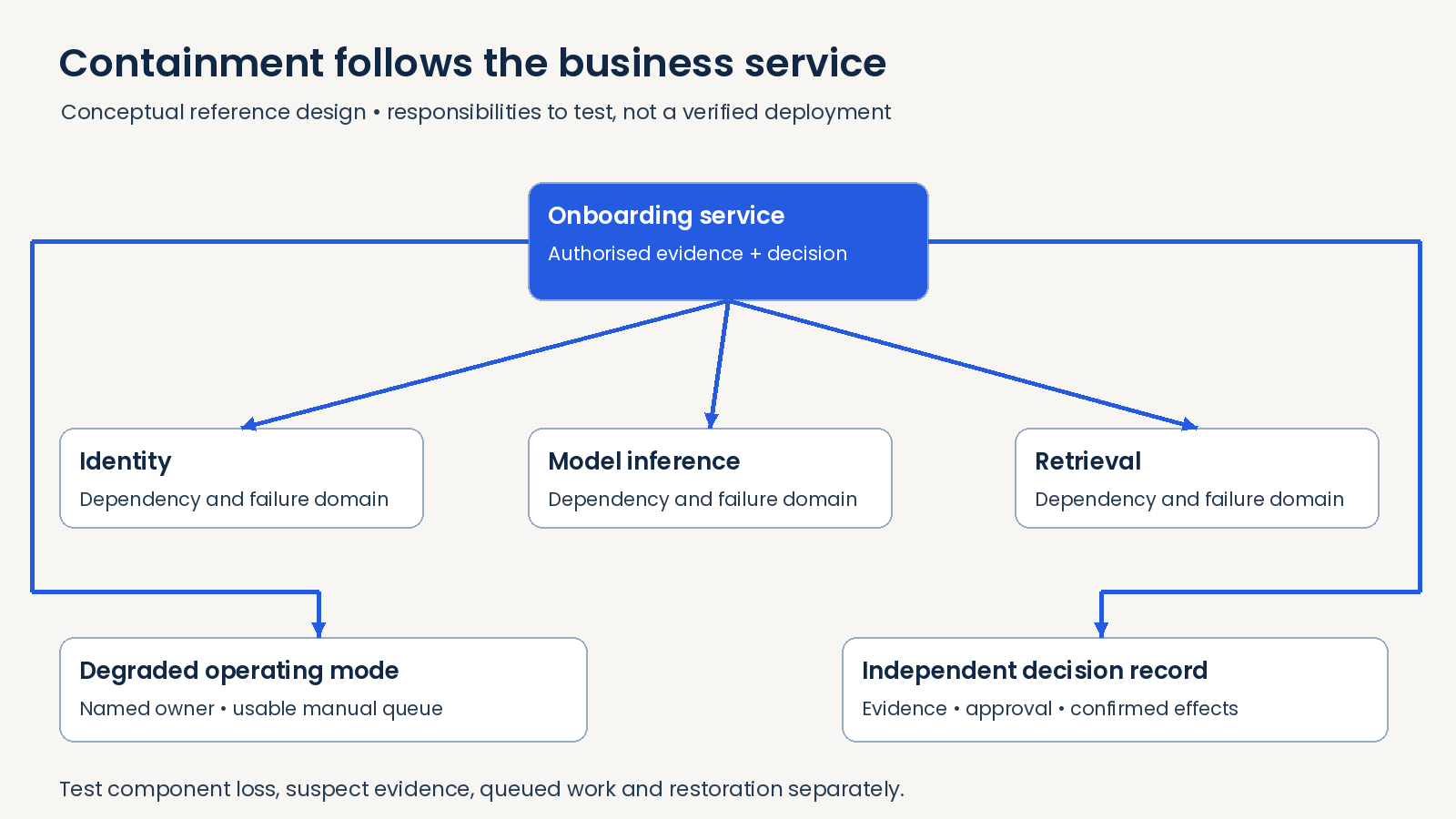
Conceptual reference design: a business service uses several dependencies, with an explicit degraded operating mode and an independent decision record. The diagram illustrates a possible allocation of responsibilities.
Containment must change effective authority
A useful containment control has an observable effect on what the system may do. Stopping new model calls while allowing queued tool writes to continue could leave the most consequential part of a workflow active. Disabling an agent in a catalogue may also be insufficient if another component retains a credential and can invoke the destination directly.
For the onboarding example, a containment procedure could suspend recommendation generation, deny automated case amendments and preserve a read-only evidence view for authorised staff. That is a proposed design. Whether it is feasible depends on the actual identities, tool gateways and destination permissions in the deployed system.
Test the control at the destination boundary. Attempt a prohibited amendment after containment, check which service denies it and inspect the resulting evidence. Also test work already queued, a worker that reconnects later and a credential issued before the incident. The goal is to establish the control’s coverage, including its exceptions.
There is a tradeoff between rapid containment and continued service. A broad shutdown is simpler to reason about but can create a large manual queue. A narrow restriction can preserve useful work but requires a more precise authority model. The right choice should follow the consequence of an incorrect action and the quality of the available detection evidence.
Degraded service is a product decision
A fallback is useful only if the organisation can perform it. “Manual processing available” is weak evidence when employees cannot access the necessary records, the queue has no owner or the operating procedure assumes the unavailable assistant will prepare the case.
A practical exercise should begin with an employee encountering an interrupted case. Can they identify the current phase, distinguish source documents from generated interpretation and see which actions are confirmed? Can another employee take over without inheriting inappropriate access? Can the team communicate a realistic service expectation while the backlog grows?
Keeping the decision record outside the model conversation can help. The record can preserve source references, the proposed recommendation, approval state and confirmed external actions. It must have its own access and retention controls. Recording everything indefinitely is neither necessary nor automatically useful.
The exercise should also distinguish unavailable evidence from suspect evidence. An outage may justify a slower path. An integrity concern may require rechecking earlier recommendations before work resumes. A recovery plan that measures only time to restart can miss the time needed to establish which previous outputs remain trustworthy.
Test restoration and dependency changes together
Restoration should establish the service’s state as well as component availability. Re-enabling inference does not demonstrate that pending cases have the correct evidence, permissions or configuration. A supplier switch can also change output behaviour, content handling or error semantics.
Use a bounded set of representative cases and retain the expected outcome independently. Introduce a model outage, a retrieval failure and a denied tool operation separately. Then test a combined failure involving a shared service. Observe whether the system enters the intended operating mode, preserves the case record and avoids unsupported completion claims.
Measure disruption duration, backlog handling, incorrect decisions, denied-action enforcement and the effort needed to reconcile uncertain work. These are suggested acceptance measures, not results reported by the ECB. A test can be valuable even when it demonstrates that a proposed fallback is too expensive to operate.
From risk assessment to service resilience
Effective AI resilience starts with a named business service and its shared dependencies. An architecture assessment should establish which actions must stop during disruption, which operations can continue safely, and who owns the decision to restore normal service. The resulting dependency map and operating procedures should be tested together.
Agent orchestration platforms can support this approach through explicit identity, persistent task records and controlled execution across system boundaries. Assess those capabilities against the actual deployment and the authority enforced by downstream systems.
The next evidence to watch is operational: whether banks can demonstrate that containment reaches queued actions, that degraded service is staffed and usable, and that restoration re-establishes trustworthy case state. The ECB’s analysis provides a reason to ask those questions now. The answers must come from the institution’s own architecture and exercises.