How to Publish to Facebook Pages and Threads from One Dashboard in 2026
May 26, 2026 • ArchyPress

The Multi-Platform Problem in 2026
According to Hootsuite's 2026 Social Media Trends Report, identities are fragmenting across social apps more than ever. A brand might post thought leadership on LinkedIn, quick updates on X, visual storytelling on Instagram, community engagement on Facebook Pages, and real-time conversations on Threads — all before lunch.
For social media managers, this fragmentation means logging into five or six different platforms, managing separate content calendars, and hoping nothing falls through the cracks. The result? Missed posting windows, inconsistent messaging, and hours wasted on platform-switching instead of creating content that resonates.
Social media users now maintain multiple identities across apps. A single, monolithic brand voice is less effective when audiences encounter brands through many touchpoints in different online community contexts.
— Hootsuite 2026 Trends Report
The solution isn't to post the same content everywhere — that's the fastest way to lose relevance. Instead, you need a unified workflow that lets you manage all platforms from one place while adapting content for each audience.
What a Unified Publishing Workflow Looks Like
A modern multi-platform publishing workflow connects all your social accounts through a single dashboard, then provides the intelligence layer to help you create network-specific content at scale. Here's the architecture that makes this possible:
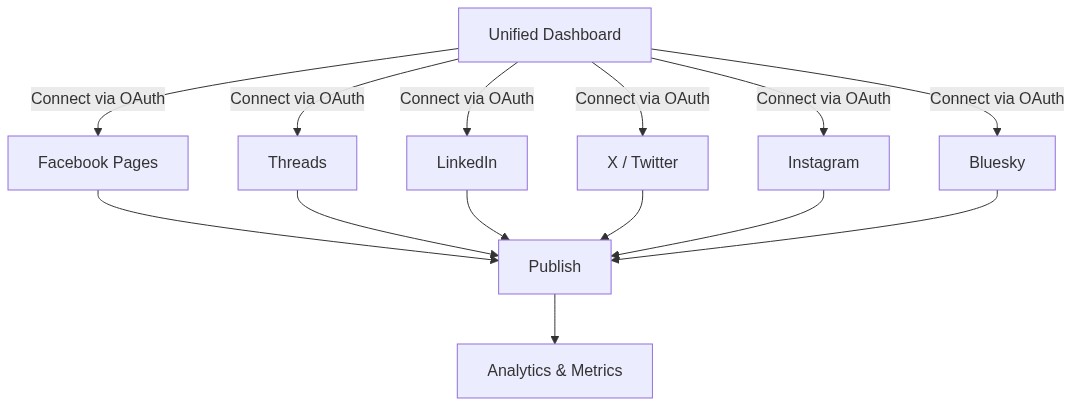
The key insight is that each platform connection goes through a capability-based validation process. Not all accounts are created equal — a Facebook Page that's connected but hasn't completed business verification can't access all publishing features. A smart workflow handles these differences gracefully.
Step 1: Connect Your Meta Accounts with Capability-Based Permissions
The first step is connecting your Facebook Pages and Threads accounts. But here's where most tools get it wrong: they ask for every permission upfront, creating a confusing OAuth experience and requesting access to data you may never use.
A better approach is progressive permissions — you start with the minimum required to publish, then unlock advanced capabilities as needed:
Level 1: Publish Ready
Basic page access + content publishing. Connect your Facebook Page and immediately start scheduling posts.
Level 2: Analytics Ready
Add page insights permissions. Track engagement, reach, and performance metrics for your published content.
Level 3: Inbox Ready
Enable comment and message management. Respond to engagement directly from your dashboard.
Level 4: Advanced
Full distribution controls including location tagging, cross-posting to Instagram, and advanced targeting.
This progressive approach means you're never sharing more data than necessary, and you can start publishing immediately without a complex setup process.
Step 2: Validate Account Readiness Before Publishing
One of the most frustrating experiences in social media management is scheduling a post only to have it fail at publish time because of a permission issue, an expired token, or a platform requirement you didn't know about.
A readiness validation system prevents this entirely. Before you can schedule content, the system checks:
OAuth token is valid and not expired
Required permissions are granted for the action you're taking
Platform-specific requirements are met (e.g., Facebook Page is published, not restricted)
Media formats meet network specifications (image dimensions, video duration)
Character limits and content policies are satisfied
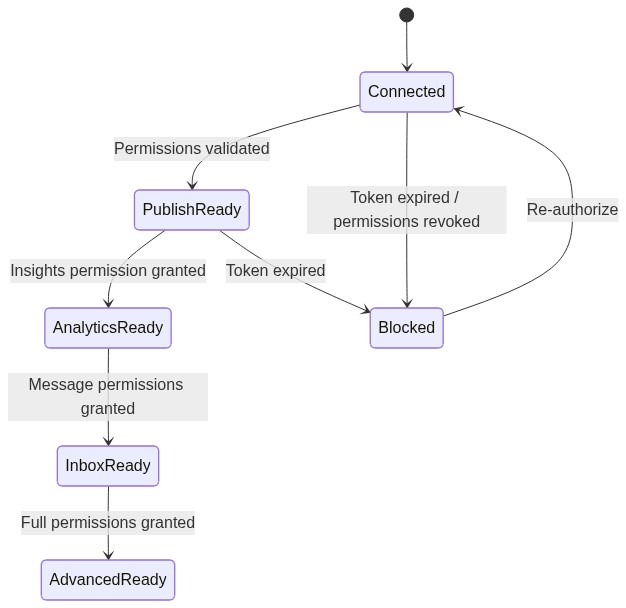
This state machine approach means your team always knows exactly what each account can do — and what needs attention before a critical campaign launch.
Step 3: Create Network-Adaptive Content
Here's where the 2026 trends become critical. With algorithms gaining nuance (Hootsuite Trend #1) and social becoming a search engine (Trend #3), you can't just blast the same message everywhere. Each network demands a different approach:
Facebook Pages
Community-focused, conversational tone. 1-3 paragraphs. Include images or video. Encourage comments and shares. Questions perform well. Optimal: 1-2 posts/day.
Threads
Real-time, authentic voice. Short-form thoughts under 500 chars. Thread multiple posts for storytelling. Lean into personality. Optimal: 3-5 posts/day.
Insight-led professional content. 2-4 paragraphs with a clear takeaway. Video gets 3X follower growth. Comments up 24%. Optimal: 1 post/day.
X (Twitter)
Hook-first, concise. Under 280 chars for maximum engagement. Use threads for depth. Strong opinion or data point as the lead. Optimal: 3-5 posts/day.
AI-powered caption generation can help you adapt a single core message across networks — maintaining your brand truth while speaking each platform's native language. The key is to start with your insight, then let the tool reformat for each audience.
Step 4: Schedule with Timezone Intelligence
Timing is everything in 2026's algorithm-driven feeds. The concept of 'best time to post' has evolved beyond simple day-of-week charts. Modern scheduling considers:
Your specific audience's active hours (not generic benchmarks)
Network-specific engagement patterns (LinkedIn peaks differ from Threads)
Timezone distribution of your followers
Content type timing (videos perform differently than text posts)
Competitive posting density (avoid the noise)
For global brands, this means scheduling the same campaign across time zones — not at the same UTC time, but at the local optimal hour for each audience segment. A post targeting your European audience should hit feeds at 9am CET, while the same campaign reaches North America at 9am EST.
Step 5: Measure Unified Analytics
The final piece of the unified workflow is cross-platform analytics. Instead of jumping between Meta Business Suite, LinkedIn Analytics, and X Analytics, you need a single view that answers: Which network drives the most engagement? Which content format performs best where? What's my overall social ROI?
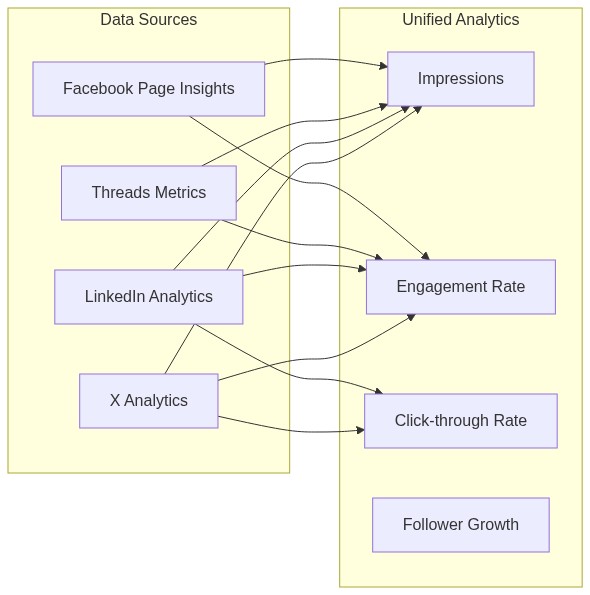
Cross-platform analytics reveal patterns invisible when viewing each network in isolation. You might discover that your thought leadership performs 3X better on LinkedIn than Facebook — or that Threads drives more website clicks than X despite lower impressions.
Best Practices for Multi-Platform Publishing in 2026
Based on the latest trends research and real-world experience managing multi-network campaigns, here are the practices that separate efficient teams from overwhelmed ones:
Start with one core message, then adapt — never copy-paste across networks
Use progressive permissions — connect with minimum scope, expand as needed
Validate readiness before every campaign launch to prevent failed publishes
Schedule by timezone, not UTC — your Australian audience doesn't care about your New York office hours
Batch content creation, then distribute — create all network variants in one session
Review analytics weekly to identify which networks deserve more investment
Automate the repetitive (scheduling, formatting) so humans focus on creative (messaging, strategy)
Keep tokens fresh — set calendar reminders 7 days before OAuth tokens expire
The ROI of Unified Workflows
Teams that consolidate their publishing workflow into a single dashboard report saving 5-10 hours per week on platform management alone. That's time redirected to content strategy, audience engagement, and creative experimentation — the activities that actually drive results.
With LinkedIn comments up 24% and Meta investing heavily in Threads growth, 2026 is the year to get your multi-platform workflow right. The brands that adapt fastest — the ones practicing what Hootsuite calls 'fastvertising' — will capture attention in increasingly crowded feeds.
Brands need to find a balance: post often enough to maintain attention and glean rapid insights while maintaining quality content. The best teams run social like a research engine.
— Hootsuite 2026 Trends Report
Getting Started Today
Whether you're managing two networks or twelve, the principles are the same: connect once, validate always, adapt content per platform, schedule intelligently, and measure everything from one place.
The multi-platform publishing challenge isn't going away — if anything, new networks and features will keep emerging. Building the right workflow now means you'll be ready to add Threads, Bluesky, or whatever comes next without rebuilding your entire process.
Ready to Unify Your Social Publishing?
Try managing Facebook Pages, Threads, LinkedIn, X, and more from a single AI-powered dashboard.