Reliable Multi-Network Publishing: How ArchySocial Handles OAuth, Queues, and Delivery
Apr 28, 2026 • ArchyPress

The hard part of publishing is not writing the post. The hard part is making sure it actually publishes — to the right networks, at the right time, with no silent failures.
At ArchySocial, we treat social publishing as a durable operational pipeline with explicit state transitions, strong auth boundaries, and production-grade failure handling. This post explains the architecture — and why every team running scheduled social campaigns needs to care about delivery semantics, not just content quality.
As part of the Archy AI Platform and Microsoft for Startups Hub, we invest in production delivery patterns from day one — not as an afterthought.
The Delivery Architecture
Post Status: The State Machine
Every scheduled post is a durable state machine in the database. There are no fire-and-forget timers — only explicit, auditable state transitions:
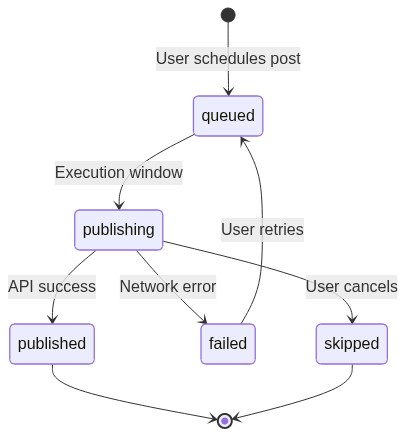
Making states explicit gives operators visibility and makes debugging tractable. When a post fails, you know which state it failed in, why, and what the remediation path is.
1) OAuth as Security-Critical Infrastructure
Multi-network publishing starts with OAuth — the delegated-auth industry standard. But the devil is in implementation details that most product teams underestimate:
State Integrity
HMAC-SHA256 signed state parameters prevent CSRF and state replay attacks on every OAuth callback.
PKCE for X
X's OAuth 2.0 flow uses Proof Key for Code Exchange — the recommended pattern for client-side flows that eliminates code interception attacks.
Encrypted Token Storage
All OAuth tokens are encrypted at rest using AES-256-GCM before writing to the database. A leaked database row cannot be used without the key.
Server-Side Token Refresh
Token refresh runs server-side in user-scoped context, never in the browser. Prevents token exposure via network tab or client-side logging.
2) Queue-Driven Scheduling
A scheduled post is not a timer. It's a durable database record with execution intent — and that distinction changes everything about how failures are handled.
Brittle publishing systems use front-end triggered timers — the post publishes if the browser tab is open at the right time. Production publishing uses durable queues:
Posts are written to the database with a `scheduled_for` timestamp and `queued` status
A pg_cron job runs every minute, selecting posts where scheduled_for ≤ NOW() AND status = 'queued'
The publish worker transitions status to `publishing` atomically (prevents double-execution)
On success: status = `published`, timestamps written
On failure: status = `failed`, error context stored for user visibility
3) Failure Handling Is Part of the Design
Network API failures are normal. Production systems treat them as expected inputs, not exceptional cases:
Pre-publish Validation
Check token freshness, rate limit headroom, and network API health before attempting POST. Fail fast, fail visibly.
Safe Transitions
Atomic status transitions via database constraints make double-publishing structurally impossible, not just unlikely.
Failure Isolation
LinkedIn being down does not affect X publishing. Each network's execution is isolated.
Retry Backoff
Exponential backoff with jitter on transient failures. Prevents thundering herds on network recovery.
4) Delivery State as a User-Facing Feature
Reliability only creates value when users can see it. ArchySocial surfaces delivery state prominently:
✓ Published to LinkedIn at 2:34 PM — 3 hours ago
✗ Failed: X API token expired. Reconnect account and retry.
⏳ Scheduled for 5:00 PM — 2 hours 14 minutes remaining
— Skipped by user
Clear state surfaces build trust. Users move from wondering what happened to knowing what to do next.
Operational Reliability Compounds
When publishing is trustworthy, something interesting happens: users start planning campaigns instead of reacting to moments. A 12-post series, scheduled across two weeks, optimised for time zones and audience patterns.
That shift — from reactive to strategic — is worth more than any single feature improvement. It makes ArchySocial a production tool, not a demo.
Start scheduling for free
Full AI generation, LinkedIn + X publishing, and reliable queue-based delivery. Free until June 1, 2026.